From Chaos to Clarity to Connection: How Lever’s Spring 2026 Release Puts the Human Back in Hiring


If you’ve ever watched Scrubs, you know it was never really about medicine.
The cases mattered, sure. But the show worked because of the connections. Between people. Between moments. Between what looked straightforward on the surface and what was actually happening underneath.
I bring this up, not just because I’m a huge Scrubs fan but because of the obvious parallels between the show and recruiting.
Which at its core, isn’t about reqs or workflows or stages. It’s about connection.
Connecting the right people to the right roles. Connecting signals across the hiring funnel. And, most importantly, connecting with candidates in a way that actually means something.
That part hasn’t changed. What has changed is everything around it.
Over the past few years, hiring has gotten…noisy. We’re talking 257 applicants per role. And while volume has always been part of the equation, the nature of that volume is fundamentally different now.
Bots flooding open reqs. Fraudulent candidates slipping into pipelines. AI-generated resumes and responses that make nearly everyone look equally polished on paper. And on the other end of the spectrum, hard-to-fill roles where the few qualified candidates you do attract slip away because no one engages them quickly enough. Tools that were meant to simplify it all? In some cases, just adding even more noise.
At a certain point, it stops feeling like a funnel. And starts feeling more like Times Square on New Year’s Eve. Crowded. Noisy. and just plain overwhelming.
That’s what we kept hearing from teams. Just how overwhelming it was in the day-to-day reality of trying to hire well in the middle of all that noise. And increasingly, how often the hiring process itself was out of step with what those companies were telling the world about themselves, particularly the ones positioning around AI, innovation, and modern ways of working.
With the Lever Spring 2026 release, the goal was simple: reduce the noise and make space for real connection again.
That meant focusing on a few critical questions:
- How do we bring more structure to the top of the funnel...where it’s arguably the noisiest?
- How do we reduce fraud risk without turning the application process into a Tough Mudder course?
- How do we help teams identify the best fit for every role, not just the most polished profile?
- How do we make sure speed of engagement matches the urgency of the role, whether you're hiring at scale or fighting to win a single specialist?
- And how do we make the rest of the process feel more seamless while we’re at it?
Here’s how we approached it.
AI Screening by VONQ: Bringing Structure Back to the Top of the Funnel
The data paints a pretty clear picture of what recruiters are up against day to day:
- Application numbers are up. Recruiters now receive 50 more applications per role than they did previously.
- But quality isn’t keeping pace. In fact, qualified applicant rate has dipped to just 11.5%.
In other words, what looks like a full pipeline isn't actually translating to real opportunity—and recruiters are feeling that disconnect.
The culprit behind this shift isn’t all that unexpected: AI. Candidates can now optimize, tailor, and apply to hundreds of roles in the time it used to take to submit a single application. Great for candidates, less so for recruiters.
Because without a structured way to evaluate that influx, volume turns into noise. Leaving recruiters to review, sort, and second-guess far more than they should. And on scarcer roles, that same lack of structure shows up differently: strong candidates waiting too long for a first conversation, eventually accepting a role somewhere else.
That’s exactly the problem we set out to solve—and one we knew required a certain level of expertise to get right.
Which is why, as part of the Lever Spring 2026 release, we introduced AI Screening by VONQ—a partnership designed to bring structured, AI-powered screening directly into the top of the funnel. Not as a filter to push candidates out, but as a way to introduce structure at the moment of application. And, just as importantly, as a way for companies positioning themselves as AI-first to walk the walk in the very part of the business candidates actually experience.
"Most AI screening is built to cut volume, not understand talent. But if you filter before you have enough signal, you're not improving quality. You're just speeding up exclusion. Instead of focusing on who you can screen out, we believe teams should prioritize who they can actually “screen in”. This mindset flip focuses on engaging every candidate to gather the missing context and assess real capability. Which ultimately makes the shortlist stronger and more defensible." - Ritu Mohanka, VONQ CEO
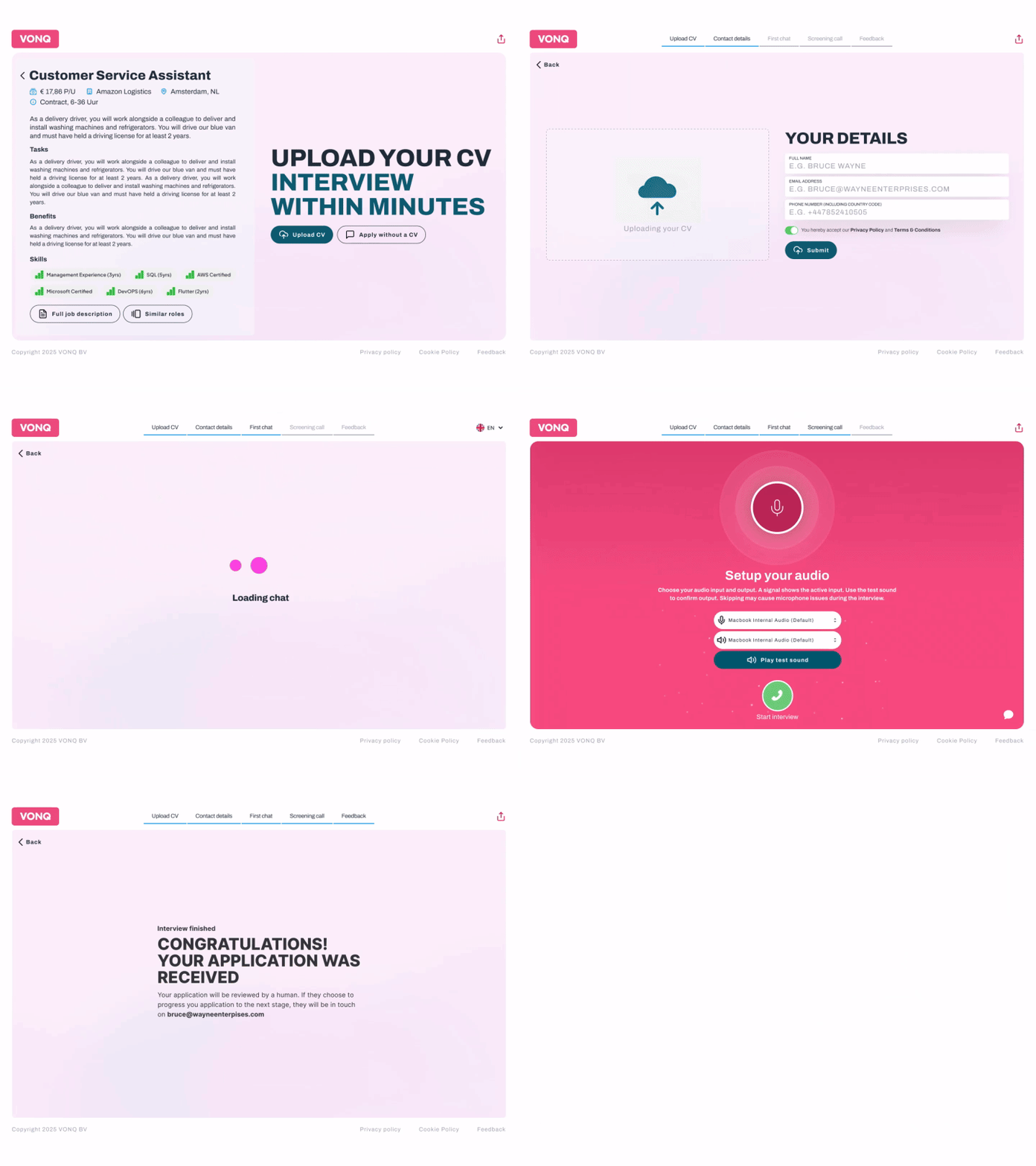
Instead of relying on static resumes alone, every candidate moves through the same structured, conversational screening experience. Whether that's one applicant for a niche specialist role or hundreds for a high-volume one, the experience is consistent, explainable, and built to surface real signal.
Ritu explains: “Imagine a candidate applies for a job over the weekend, when your team is offline. Instead of sitting in a queue, the candidates are already being engaged—guided through a consistent set of questions that start surfacing real signal right away.”
By the time your recruiters log in on Monday, they already have a list of pre-screened candidates from the weekend they can reach out to with thoughtful follow-up.
And that’s a shift candidates and recruiters can feel.
For candidates that looks like:
- A more interactive application experience—less “submit and wait,” more immediate engagement after applying.
- A consistent process that evaluates responses against the role, not just generic benchmarks or gut feelings.
- A chance to demonstrate their skills and how they think, not just what they’ve written in their resume or in their application.
For recruiters:
Every pre-screened candidate comes with a structured Candidate Dossier delivered directly into Lever, providing the context and scoring to evaluate faster and decide with confidence. The Candidate Dossier includes:
- A structured summary and CV of the candidate.
- Screening insights aligned to role criteria and full interview transcript.
- An explainable score highlighting candidate fit, so every decision is easy to understand and defend. Built to support fair, auditable hiring practices, including alignment with the EU AI Act.
- A standard profile that can be reviewed in seconds.
As Laura Mazzullo, Recruiter and Owner of East Side Staffing, put it:
“Recruiters want to find qualified, interested candidates who align with the opportunity. It's not just about filling funnels, it's about finding the right match, faster.”
And with AI Screening by VONQ, Lever customers now have the tools to do just that.
And the impact? Immediate. Not just in terms of speed (although teams are seeing 2.5x faster time to fill and cut manual screening time by 70–90%) but in confidence. Confidence that your recruiters are spending their time connecting with the right candidates, whether that's the one specialist who'll define a quarter or the next hundred hires that'll define the year. Not drowning in the noise.
When “Looks Good on Paper” Isn’t Enough: Filtering the Fakes with Fraud Signals
At the top of the funnel, the challenge is volume and relevance. A few steps later, it becomes something else entirely: trust.
And that’s where things get more complex.
By 2028, Gartner predicts that 1 in 4 applicants could be fake. And when you factor in the cost of a single fraud incident—not just financially ($28,000 per incident), but in lost time, productivity, and team impact (up to a 20–30% hit to team efficiency)—this stops being a fringe issue. It becomes something teams have to design for.
Which raises a practical question: how do you identify risk early enough to make a difference without adding friction that slows everything (and everyone) down?
Our answer: Fraud Signals.

From the moment a candidate applies, Fraud Signals evaluates patterns that may indicate risk (think of it as an automated Sherlock Holmes) surfacing signals within Lever that help recruiters quickly understand where something may not fully add up.
Within each candidate profile, recruiters can see how individual signals are evaluated across areas like:
- Email address validity
- Phone number authenticity (including detection of virtual numbers)
- Application behavior, such as bot-like patterns
- Work history consistency and verifiability
Each signal is labeled—verified, suspicious, or flagged for review—so it’s easy to understand what’s been validated, what may not add up, and where a closer look is worth the time.
Critically, no one is ever automatically rejected. That decision was deliberate. Because while automation can surface patterns, interpretation still requires context. And that context sits solely with the recruiter.
And the results aren’t just theoretical. We’ve already seen how this can impact TA teams. In a pilot with Lever's own TA team, Fraud Signals flagged 30 suspicious candidates out of 121 applicants in just one week.
As our Senior Talent Business Partner, Josh Cea, put it: "Fraud Signals has served as a great gut check and reference point when things are seeming too good to be true. It has allowed me to surface potential fraudulent candidates and allowed me to send appropriate communications to candidates to verify parts of their profile."
That’s time redirected. Risk surfaced earlier. And more focus on the work that actually moves hiring forward.
A Better Lever Experience
Even the strongest signal doesn’t go far if the system around it gets in the way.
We have a saying here that gets to the heart of it: Hiring is hard. Your tech shouldn’t be.
And this is where a different kind of feedback tends to show up. In conversations with customers, one theme came through clearly: it’s often the smaller moments that shape how it really feels to use a platform.
The extra clicks. The workflows that almost work the way you expect them to. The little things that aren’t broken...but could be smoother.
So part of this release focused on those moments. Not just headline features, but thoughtful improvements to how the platform works in practice:
- A more intuitive interface with better contrast and navigation.
- More flexible job posting tools with easier editing and structure.
- Simplified application workflows with reusable custom questions.
- A streamlined Automation Hub for faster workflow management.
Individually, these are small changes. Together, they make the experience feel more natural—so teams can spend less time navigating the system, and more time focused on the work itself.
Up Next! Finding the Right Fit with Talent Fit Custom Matching
Even after filtering out risk and strengthening signal, there’s still another challenge: alignment.
Not every role has the same requirements. I can already hear it...“well, duh.”
But when teams are moving quickly, it’s easy to default to the same evaluation criteria across roles. It feels efficient in the moment.
TL; DR: It’s not.
Because when everything is measured the same way, signal gets diluted.
Strong candidates get buried. Recruiters spend more time sorting through mismatches. And decisions take longer.
Not because there isn’t enough data, but because the data isn’t aligned.
Talent Fit Custom Matching is designed to bring that alignment back.

It allows teams to tailor evaluation criteria by role, using weighted scoring across the factors that actually matter—skills, experience, education, certifications, and more.
In practice, it shifts the question from: “How does this candidate compare overall?” to: “How well does this candidate match this specific role?”
It’s a subtle shift, but it has a meaningful impact on both speed and confidence.
Bringing It Back to What Really Matters
At the end of the day, all of this ladders back to something that hasn’t really changed.
Recruiting works best when it creates the conditions for real connection.
Less time navigating systems. More time understanding candidates. Less effort spent validating what’s real. More energy spent building relationships that actually move hiring forward.
Because that’s still where the impact happens.
Technology plays a role in all of that—but it’s a supporting one. And our goal isn’t to make hiring feel more automated. It’s to make it feel more intentional.
And when we get that balance right, recruiting gets back to what it’s always been about.
Connection.

Chief Product Officer, Employ
Dara Brenner is the Chief Product Officer of Employ Inc. who brings more than 25 years of executive leadership experience spanning product vision, business strategy, and organizational excellence. She has a proven track record of delivering customer-centric solutions, guiding companies through transformative growth, and building future-ready operating models. As Chief Product Officer at Employ, she has spearheaded a major evolution of the company’s product portfolio, including the integration of AI capabilities. Under her leadership, Dara set a new standard for HR technology, advancing the product strategy and delivering solutions that redefined how employers and job seekers connect. Dara has held senior leadership positions at ADP, Equifax Workforce Solutions, and Ultimate Software/UKG, where she shaped strategic direction, drove operational advancements, and delivered industry-leading workforce technology. Notably, she founded and scaled ADP’s first Innovation Lab, pioneering the adoption of agile practices that reshaped how teams collaborated and accelerated delivery of forward-looking solutions across the organization. As CEO of Employ, Dara is committed to advancing the company’s mission to reshape the hiring experience. She is passionate about driving product evolution, enabling long-term customer success, and ensuring that Employ continues to lead with innovation, integrity, and impact in the HR technology space.
Connect on LinkedIn